The System I No Longer Hold in My Head
It kept working, so I stopped looking. The day it failed, I found a machine I no longer recognized as mine.
Fourth in a side series. The first three are here, here, and here.
The earlier posts in this series were about a doubt I could name: I could not tell whether a summary was right, because it fell outside my field. This one is about a different doubt, and it took me longer to see it. It is not that I cannot check the output. It is that I no longer fully hold the thing that produces it.
The morning it stopped
I had two machines running this pipeline — one at home, one at the clinic — and I decided to swap their roles. The home machine, which I open first and last each day, should be the one that sends. Simple enough. I made the change in the evening and thought little of it.
The next morning, the papers I had added were not there.
What followed took most of a day. The first cause was a filename: the machine was writing new papers to one file, and the part that watches for new papers was reading a different one. I fixed that, and a second cause appeared underneath — a push rejected because the cloud had changed first. I fixed that, and a third appeared: the files were arriving but staying invisible, blocked by a permission I did not know a background process needed. Behind that, a fourth: a conflict between two things both trying to sync the same folder.
Each fix revealed the next. None of them were in the part of the system I had understood when I built it. They were in the seams — the places where one piece hands to another, which I had wired together without ever really looking at.
What I noticed about my own understanding
Here is the uncomfortable part. When I built this, I could hold all of it in my head. Seven stages, each of which I had typed out myself. I knew what every line did because I had struggled with every line.
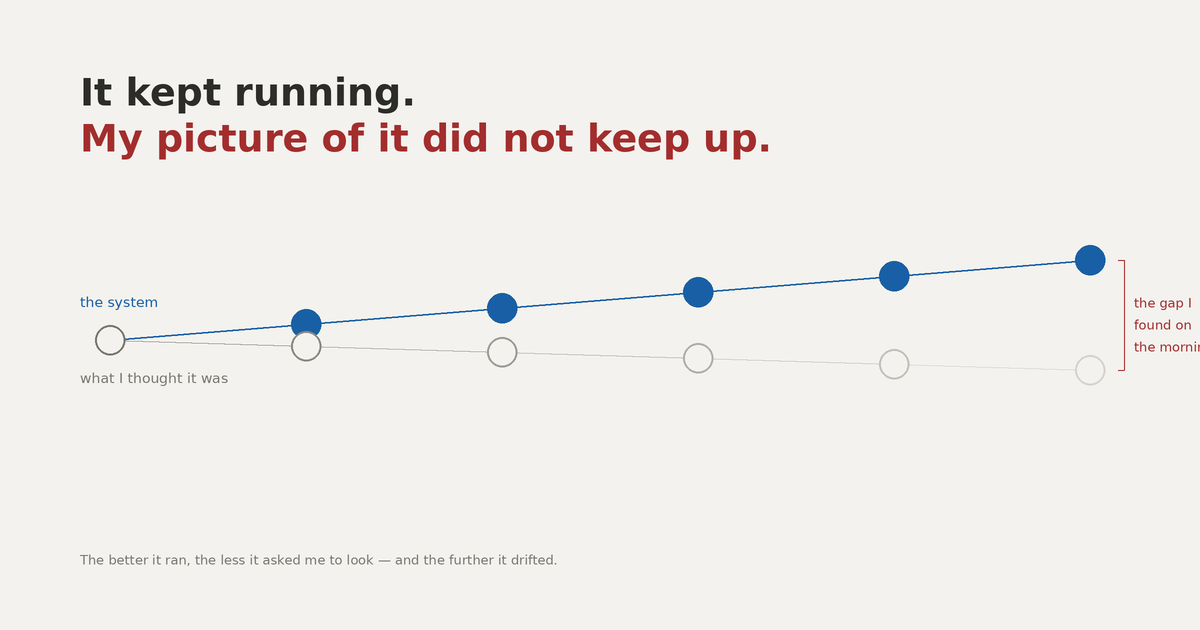
But that was weeks ago, and the system had drifted since. I had changed the prompt. I had reversed the two machines. Small edits, each sensible at the time, had accumulated into a machine that no longer matched the picture in my head. When it broke, I was not debugging the system I understood. I was debugging a system that had quietly moved on without me, and I was discovering, live, how far it had gone.
This is not a complaint about complexity. It is a specific observation about what happens to a thing you have automated and then stopped looking at. It keeps working, so you stop watching. And because you stop watching, you stop updating your understanding of it. The gap between what it is and what you think it is grows in silence, and you only learn the size of that gap on the morning it fails.
Handing it over
Late in that day, I did something I had been circling for a while. I stopped trying to fix it by hand and gave the problem to an agent — an AI that could read the actual files, not my memory of them.
It found things I had not. The permission block. The sync conflict. A stale copy of a script, sitting in the repository, still pointing at the old filename — a trap that would have recreated the whole morning's failure the next time I set up a new machine. I had looked at these files. It read them.
I want to be honest about how that felt, because it is the actual subject of this post. It was a relief, and it was slightly disquieting, and the two did not cancel out. The relief is obvious — the thing got fixed, faster and more correctly than I was managing. The disquiet is harder to name. It was the recognition that the most reliable way to understand my own system was now to ask something else to read it for me.
The pattern I keep landing on
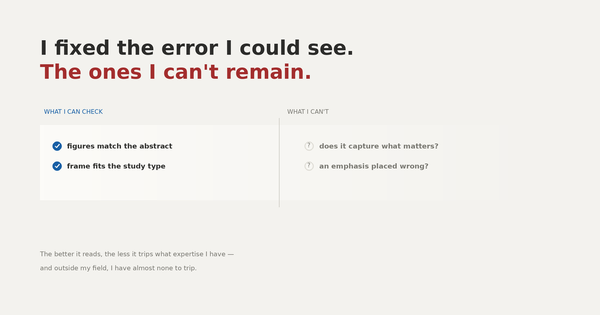
In the third post I wrote that fluent output is the hardest kind to check, because the better it reads, the less it trips whatever expertise I have. I notice the same shape here, one level up.
A system that runs smoothly is the hardest kind to know, because the better it runs, the less it asks you to look at it. Reliability and understanding pull apart. The thing works, so you leave it alone, so you understand it less, so that when it finally needs you, you arrive as a stranger to your own machine.
I do not think the answer is to build less, or to automate nothing, or to refuse the agent that reads better than I do. The papers are getting read. The mornings are shorter. Those were real problems and they are genuinely smaller now. But I am trying to hold onto a modest discipline: to open the thing occasionally when it is not broken. To read a summary I do not need to read. To look at the seams before they fail. Not because I will catch everything — I have now proven to myself that I will not — but because the alternative is to understand my own tools only in the moments they stop working.
Where this leaves the series
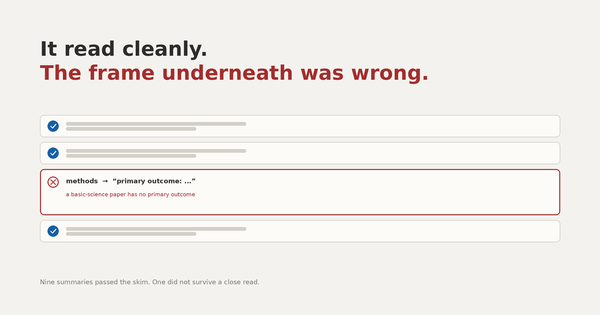
I started this series to write about automating my reading. Four posts in, I notice that each one has really been about the same thing: the distance between a system that works and a person who understands it. The summary that reads well but might be wrong. The prompt that produced good output for the wrong reason. The pipeline that ran for weeks while quietly drifting from the picture in my head.
I do not have a resolution, only a direction. Build the thing. Use the thing. And keep looking at the thing, deliberately, on the ordinary days when it is giving you no reason to — because those are exactly the days your understanding of it is slipping, quietly, without telling you.