The Summaries Looked Good. Then I Read One Properly.
I was about to call the AI summaries a success. Then I read one properly, and found a mistake I'd only caught because it happened to be in a field I know.
Second in a side series. The first is here.
In the first post I built a system that summarizes papers and turns them into infographics, and I made two predictions about where it would fall short. Nine papers later, I was ready to write that both predictions were wrong and the thing just worked. Then I read one of the summaries carefully, and had to write something more complicated instead.
The two things I expected to break
The prompt I borrowed was written by a gastroenterologist for clinical trials. Its structure asks for study design, population, exclusion criteria, primary outcome, statistical methods — the anatomy of a randomized controlled trial.
My library is not made of trials. It is systematic reviews, consensus reports, and — because I do not only read dentistry — miscellaneous topics such as basic science, foreign affairs, and sometimes literature. So I predicted two failures. First, that the trial-shaped template would leave large gaps for anything that was not a trial. Second, that the image model would invent charts it had no numbers for.
What it looked like
Neither seemed to happen.
Across nine papers — periodontal reviews, a consensus document, cancer research from Nature — the summaries read cleanly. Nothing was left as an awkward labelled blank. The infographics did not fabricate graphs. A basic science paper got a summary that read like it was written for a basic science paper. I had braced for a template fighting against the wrong material, and instead it seemed to flex around whatever I fed it.
I was, at this point, about to declare success.
Then I read one properly
The mistake I had been making was reading the way you skim: top to bottom, checking the sentences made sense and the facts matched the abstract. On that standard everything passed. So I slowed down on one — a Nature paper that re-ran early tumour evolution in inbred mouse strains, nothing to do with a clinical trial.
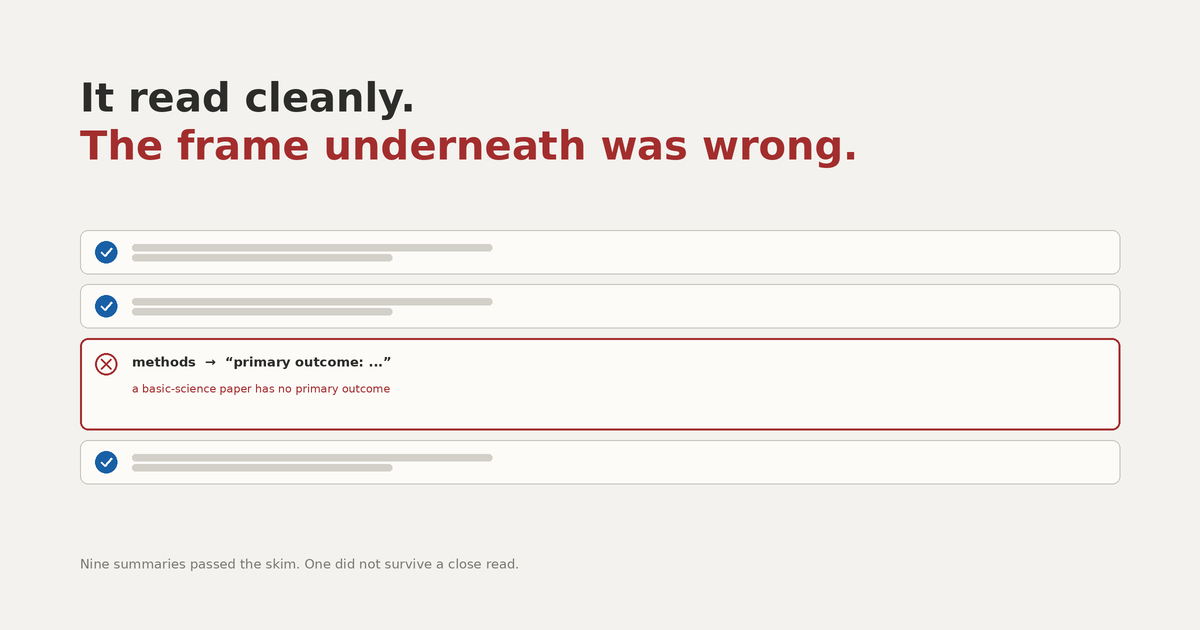
The facts were right. But under "methods" it had written: primary outcome: selection of driver mutations; secondary outcome: cancer susceptibility, tumour growth rate.
A basic science experiment does not have a primary outcome. "Primary outcome" and "exclusion criteria" belong to clinical trials — studies that give an intervention to people and measure a pre-specified effect. A mouse tumour-evolution study has an experimental design, controls, all of it, but describing them in trial language is a category error. Nobody who does this research would frame it that way.
So the summary was not inventing facts. It was doing something quieter. The template asked for a primary outcome, and rather than say "this does not apply here," the model found something in the paper to label as one. It filled a box that did not belong on the form. My first prediction had it backwards: the danger was not empty fields, it was fields filled too willingly.
Why I nearly missed it
This is the part worth being honest about.
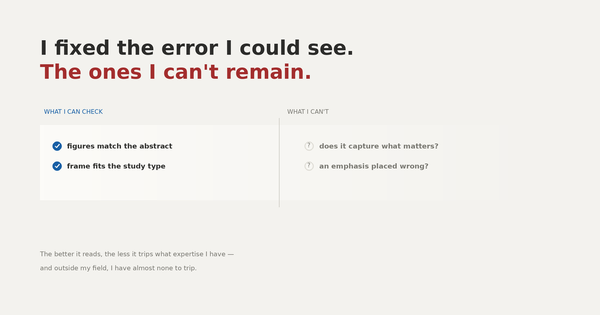
I nearly missed it for exactly the reason I could not have caught it in most of the nine papers: I do not do cancer genomics. When a summary of a periodontal review misstates something, my own knowledge flags it. When a summary of a Nature oncology paper quietly forces a trial frame onto basic research, I have no reflex that says that word does not belong there.I caught this one only because the mismatch happened to be blatant enough to see from outside the field.
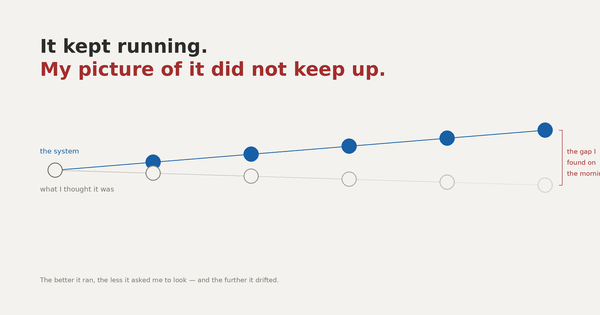
Which means the standard I was about to publish — "these read naturally to me" — was measuring the wrong thing with the wrong instrument. A summary reads naturally to me precisely when it does not trip my expertise. Outside my field I have no expertise to trip. The smooth ones are the ones I am least equipped to check, and most of my library is outside my field.
What I actually learned
Not that the system failed. The facts were accurate every time I could check them, and no charts were invented — my second prediction really was wrong. What failed was my test. "It reads naturally" tells me a summary has not made a mistake I can recognize. It says nothing about mistakes I can't.
That is a more useful thing to know than "it worked," and I would not have known it if I had published a day earlier. The next post is about the fix — rewriting the prompt so it stops assuming every paper is a trial — and about the part of this that a rewrite cannot fix.